Crop classification using satellite images and analytics
EOSDA’s crop classification solution offers accurate, scalable, and fully managed satellite imagery analytics powered by AI. It helps organizations make smart, data-driven decisions across the agricultural value chain.
- Up to 90% accuracy
- API integration
- Customizable reports

Benefits of crop clasfification solution by EOSDA
Short-term optimization
- Enhanced production and sourcing planning.
- Supply chain optimization.
- Improved field management & resource optimization.
- Easier agricultural loan/ insurance risk assessment & management.
- Easier monitoring of compliance with agricultural programs.
Long-term impact & resilience
- Smarter market analysis based on agricultural insights.
- Easy collection and storage of agricultural data.
- Ability to support food security policies and regulations.
- Smarter land use planning & sustainable resource management.
- Bioenergy feedstock assessment & monitoring.
Approach and methodology of our AI-powered crop classification
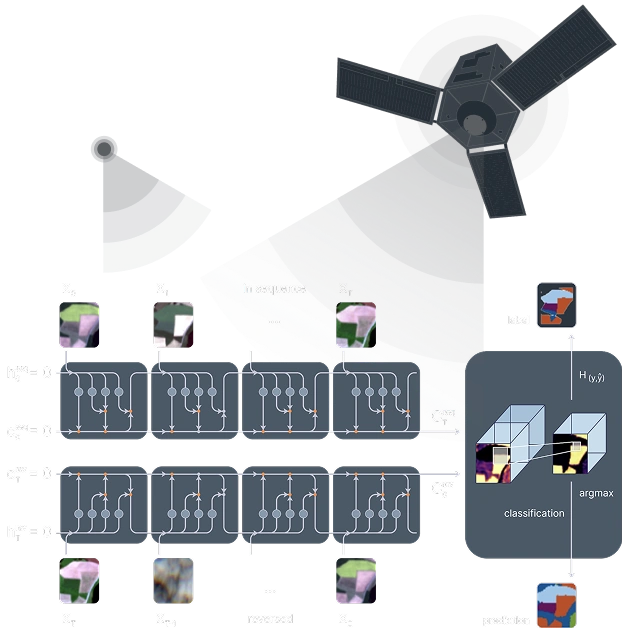
Model: EOSDA uses a multi-level Conv-LSTM architecture that integrates spatial (CNN) and temporal (LSTM) analysis. Using a full-season time series imagery analysis, the model captures crops' spectral changes across growth stages, significantly improving detection accuracy.
Satellite data: The model uses imagery from Sentinel-2 L2A satellite, which collects data 8 spectral bands (RGB, 2 Red edge, NIR, 2 SWIR).
Crops: The model was trained on data from over 20 crop types across various countries and can be adapted to any crop if ground truth data is provided.
Accuracy: up to 90%.
Limitations: Regions with high cloud cover and fields smaller than 2 ha.
Expected project outputs and formats
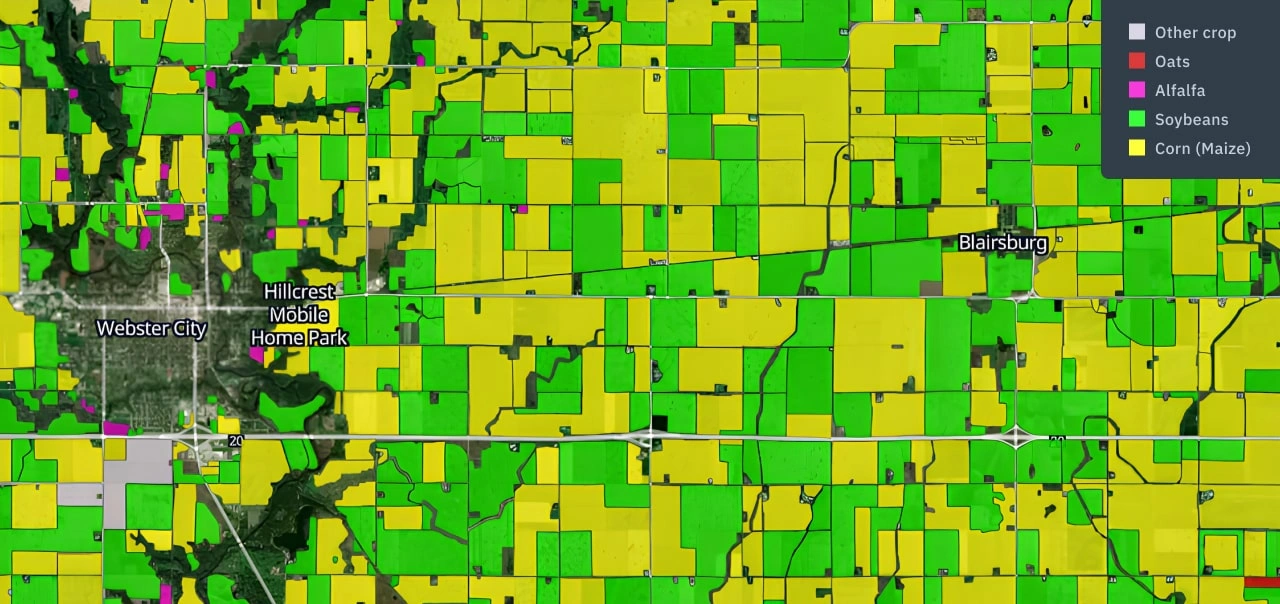
- Classification raster mask limited to the AOI in GeoTIFF format.
- Vector mask with field boundaries in ESRI shapefile, GeoJSON, KML, or GPKG.
- Aggregated statistics by admin boundaries of regions, districts, etc in xlsx, ot csv.
- Analytical report or results interpretation note, if required.
*Delivery in another format, including via API interface.
Required data for AI-powered crop classification
Input data provided by customer
- Area of interest in table (xlsx/ csv) or vector (KML, ESRI shapefile, GPKG, GeoJSON) format.
- List of the target crops.
- Crop сalendar, if available.
- Ground truth data (examples of the field with the target crops for model training), if available.
Data prepared by EOSDA
- Phenology data.
- Satellite imagery.
- Training datasets for general land cover classification (and target classes if not available).
- Validation datasets.
Standard project stages
Typical project duration: 3-6 weeks.
Investigation of vegetation features for AOI.
Ground data collection, verification, and filtering.
Search and download of required satellite data.
Model training and crop classification.
Result verification and final outputs preparation.