
European Space Conference: Where The Industry Is Headed
On 27–28 January 2026, the 18th European Space Conference brought together Europe’s main space institutions, industry leaders, and policymakers in Brussels. With more than 2,000 attendees and over 65 panels, the conference focused on how Europe can strengthen its space capabilities, improve coordination, and turn satellite systems into tools that support real operational decisions. EOS Data Analytics was represented at the event by Managing Director Oleksii Shchegliuk, who attended key sessions on Earth Observation and satellite intelligence.
One of the central themes repeated throughout the conference was Europe’s need to reduce fragmentation and build stronger, more coordinated space systems. In his keynote address, ESA Director General Josef Aschbacher compared Europe’s space investment levels with those of the United States and China, pointing out the large gap in funding and calling for a significant increase. He also stressed the importance of faster processes, less bureaucracy, and greater use of technologies such as artificial intelligence to keep Europe competitive and resilient.
One of the key sessions Oleksii Shchegliuk attended was “Evolving Needs and Capabilities for Earth Observation.” Speakers from ESA, the European Commission, EUMETSAT, Airbus, ICEYE, and other organizations stressed that the future of Earth Observation is not about producing more satellite data but about turning it into user-focused, decision-ready information.
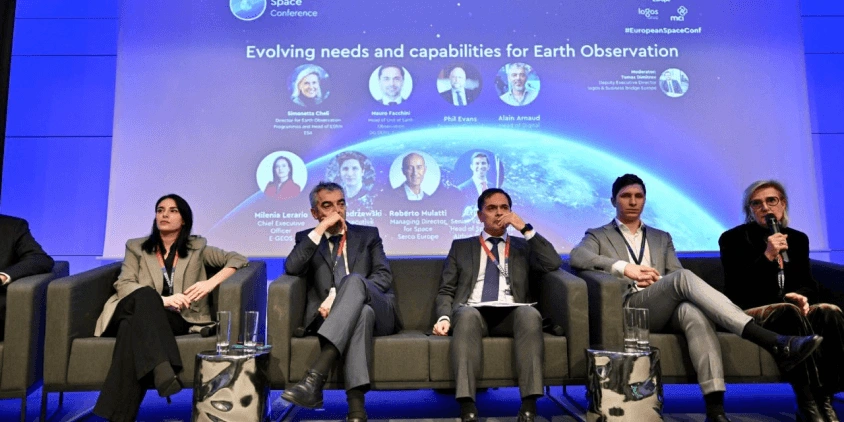
The satellite analytics sector today is no longer focused on collecting more imagery. The priority is to switch from image delivery and basic analytics to building intelligence systems that provide users with real insights and help them understand situations early and act faster. This is where advanced analytics and AI become critical — and where EOSDA already has strong expertise.
Another major point across discussions was the consolidation of Europe’s satellite resources. ESA and EU speakers explored the idea of unified access to European satellite capacity and closer integration of different satellite constellations. This focus on consolidation was stressed by Timo Pesonen, Director General of DG DEFIS, who promoted a step-by-step approach to building space capabilities with realistic yet ambitious goals.
The European Commission’s Commissioner for Defence and Space, Andrius Kubilius, also underlined Europe’s growing commitment to strengthening its space infrastructure. He highlighted the launch of EU GOVSATCOM as a major step toward secure satellite communications and noted that space is becoming a core strategic priority for the European Union.
The European Union also reaffirmed its strong commitment to space sovereignty. Following the recent ministerial meeting in Bremen, a record budget of $22.3 billion was approved to expand Europe’s satellite infrastructure and increase the use of European-built components, aiming to reduce external dependencies and strengthen long-term stability.
Overall, the 18th European Space Conference showed that Europe is moving toward stronger coordination, larger investment, and a clear shift from raw satellite data to intelligent, user-focused solutions. For EOS Data Analytics, the discussions closely align with the company’s focus on turning Earth Observation into practical intelligence platforms — where integration of many sources, real-time data streams, and AI-powered insights drive value across industries.


