EOSDA Models Climate Change Impact On Sugarcane Yields
Farmers in Veracruz, Mexico’s top sugarcane-producing state, feel more and more uncertain about the future of their industry due to climate change. To take actions, they need to understand how temperature, rainfall, and other climate conditions will affect the quantity and quality of sugarcane yields in the coming decades.
EOSDA approached this challenge with a comprehensive model of how various climate scenarios could influence future yields and sucrose content. These findings give sugarcane growers a clear roadmap to adapt and thrive in the changing climate.
| Challenge | Sugarcane growers and mills in Veracruz needed reliable, region-specific predictions of how climate change may affect future biomass and sucrose levels, as existing information was too general for practical planning. |
| Solution | EOS Data Analytics combined CMIP6 climate projections with the WOFOST crop growth model to estimate future sugarcane performance under two emission scenarios. |
| Outcome | The modeling indicated probable declines in yields and sugar content, increased production variability, and more pronounced heat- and water-stress impacts across the state, which are practical for adaptation planning. |
Overview: Sugarcane Industry In Veracruz
Veracruz is Mexico’s main sugarcane region, producing about 40% of the country’s cane and sugar, far more than any other state. The industry supports rural communities and relies mostly on smallholders who supply nearby mills. Each year, the state processes about 20 million tons of cane grown on around 350,000 hectares .
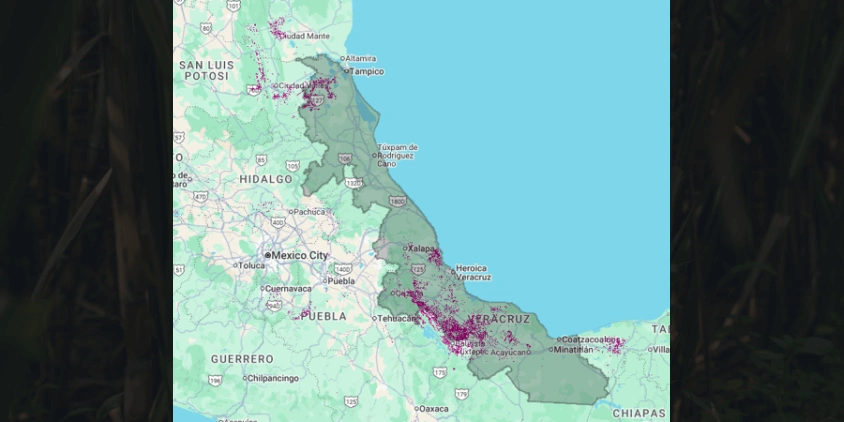
Despite this huge scale, productivity leaves a lot to be desired: many farmers report yields about 12% below the region’s natural potential . One of the primary drivers of this shortfall is climate change. Long-term observations in central Veracruz show higher maximum temperatures, greater evaporative demand, and shifts in rainfall timing. These trends increase water and heat stress in rainfed fields, which means reduced stalk growth and lower biomass.
If current trends continue, crop yields could drop by up to 20% by 2100, mostly because of less and more unpredictable rainfall . Higher CO₂ may slightly boost yields, but it is not enough to offset stronger water stress. As a result, both biomass and sucrose content are expected to become more variable unless varieties and management adapt. Encouragingly, pilot programs in the state demonstrate that improved agronomic practices can significantly boost yields — from around 55–60 t/ha to over 75 t/ha — even under dry conditions .
Challenge: Integrating Multiple Climatic Parameters On The Regional Level
It’s hard to model how climate change will affect sugarcane in Veracruz because temperatures and rainfall are changing in different ways across the state. To get reliable results, this uneven pattern must be captured correctly. The combination of gradual changes and extreme events makes the modeling process even more complicated.
To better understand these issues, let’s look at key climate components that should be modeled:
- Temperature. Average temperatures are rising. What’s worse, there are projected many more days with temperatures exceeding 35°C, above sugarcane’s optimal growth range (8°C to 34°C). As these extremes reduce photosynthesis, increase respiration, and ultimately decrease sugarcane biomass accumulation, it’s critical to consider them in predictive models. Uneven warming across regions also requires careful consideration.
- Rainfall. General projections indicate changes in total precipitation and shifts in seasonal distribution. At the same time, precipitation may increase greatly in certain locations while dropping dramatically enough in others to cause prolonged droughts. These contrasting patterns complicate statewide modeling.
- Other climatic variables. Increasing evapotranspiration and solar radiation must also be integrated into the models. They indirectly influence biomass formation and sucrose levels, and their effects need to be represented alongside temperature and rainfall trends.
The coarse resolution of Global Climate Models (GCMs) makes it even more difficult to model localized climate impacts. This necessitates downscaling of resolution to predict climate variables at the local and regional levels.
Overall, the main challenge is building a consistent analytical framework that can integrate multiple climatic parameters and provide reliable predictions on sugarcane performance in Veracruz’s changing climate.
Solution: Modeling Biomass And Sucrose Changes Under Different Scenarios
The EOSDA science team analyzed two plausible climate scenarios, or Representative Concentration Pathways (RCPs), covering the years 2025 to 2035, to help agricultural stakeholders in Veracruz better understand potential impacts on sugarcane biomass and sucrose content. These scenarios are:
- stabilization scenario (RCP 4.5), which implies that greenhouse gas emissions will peak around 2040 and then gradually decline due to actionable climate policies applied;
- high-emission scenario (RCP 8.5), which implies that greenhouse gas emissions will rise throughout the whole 21st century, because minimal climate policy action is taken.
Data for modeling both scenarios was received from an ensemble of three CMIP6 Global Climate Models, well-suited for agricultural modeling, particularly for running WOFOST (World Food Studies) simulations . By using several models together, we get robust predictions and avoid depending too much on one model.
A multi-model ensemble helps better quantify climate uncertainty and produce more reliable, less model-specific predictions for sugarcane yields.
Since coarse GCM grids cannot represent local differences and extremes, the EOSDA science team downscaled it to about 27.75 x 27.75 km grids. Bias correction was then applied to ensure that the climate inputs used in the simulations match the patterns observed in Veracruz historical datasets as closely as possible.
Additional datasets helped make the model inputs more reliable. Сrop parameters required by the WOFOST model (e.g., phenology and biomass partitioning) come from scientific studies and local field observations. Historical regional statistics on sugarcane yield, sugar content, and production from 2009 to 2024 serve as a reference point to validate the model outputs and support credible estimates.
Processed climate and crop data were fed into the WOFOST crop growth model, which simulates temperature and water stress effects on development rates, yields, and sugar content. This simulation enabled linking specific climate variables, such as irregular rainfall or extreme temperatures, to changes in final sugarcane yield and sucrose concentration.
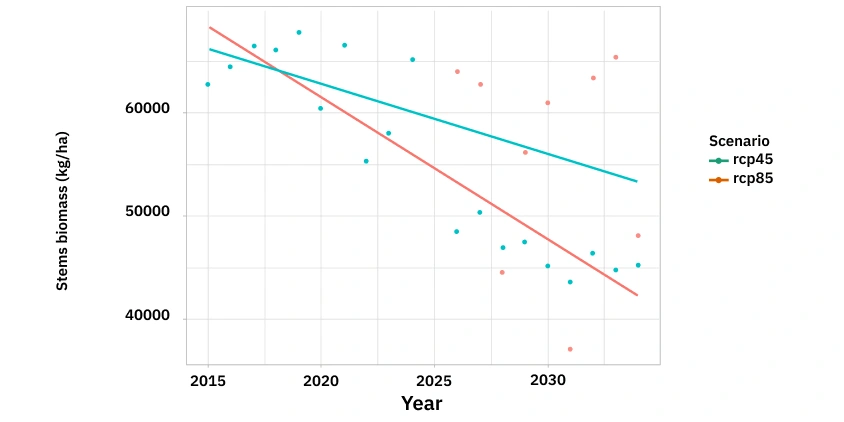
By combining high-resolution climate projections and a validated crop model, this framework integrates multiple climate variables and links them to sugarcane yield quantity and quality. It provides a consistent basis for assessing how biomass and sucrose levels may change across Veracruz under future climate conditions.
Outcome: Practical Takeaways To Support Long-Term Adaptation Strategies
The project showed that EOSDA’s approach can turn complex climate data into practical insights for growing sugarcane in Veracruz. Our modeling results point to a future where climate change will not only lower sugarcane yields in Veracruz but also make production harder to predict. Even though average temperature rise seems moderate and can even accelerate growth, the real issue is the increasing frequency of extreme heat events. Heat stress reduces biomass accumulation, thus yield quantity, and sucrose formation during the maturation phase, which directly affects yield quality.
We’ve also projected that some areas will receive more rain, but others will experience long dry spells. Because of this uneven pattern and more water loss from heat, water stress will become more frequent, especially in rainfed fields. This stress is a key reason for lower yields in both climate scenarios.
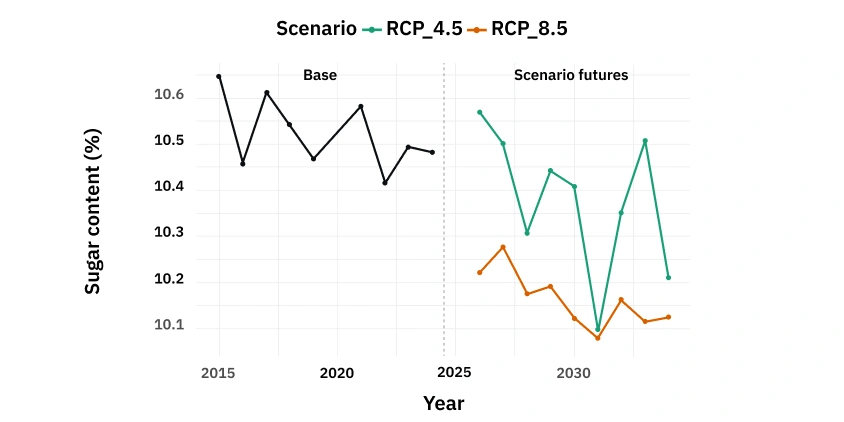
The model predicts a decline in both biomass and sugar content across the state. The high-emission scenario shows stronger losses, but even the moderate scenario points to noticeable reductions by 2035. Sugar concentration is expected to fall from 10.7% to about 10.2%, reducing the crop’s value. The analysis also indicates a higher chance of “production whiplash,” where yields swing sharply from very low to unexpectedly high from one year to the next.
At the same time, EOSDA’s findings underline that adaptation is possible. Adjusting sowing dates to avoid peak heat, investing in improved irrigation, and selecting drought-tolerant varieties can help reduce climate-related stress. New agricultural technologies may further support growers as the climate changes.
About the author:
Maksym Sushchuk is at the forefront of realizing EOSDA's vision to make space tech a global driver of sustainability on Earth. He has over 15 years of experience in journalism and content creation for prominent Ukrainian startups, charitable funds and ESG businesses. As Head and Co-founder of PR Army Maxim brings attention to the human and social tolls of the aggression against Ukraine.
Recent articles
EOSDA to Monitor Wildfires in Portugal Using Satellite Data Under ESA’s InCubed Programme
The company signed a contract with ESA to create an innovative satellite-based solution for forest monitoring and wildfire prevention.
EOSDA Forecasts Yields For 2025 In Saskatchewan
EOSDA created RM-level crop yield forecasts for Saskatchewan to address limitations of official data. The project shows how satellite and weather inputs reveal local yield changes during the season.
Digital Tools Improve Soil Health And Yields In Mexico
EOSDA and ITTA supported a Guanajuato farm with contour-line planning, monitoring tools, and practical guidance to reduce soil erosion and improve yields in the long run.